Starts at Home needs your assistance to help determine what kinds of parenting class would be of interest to parents with young children. Please answer the one (1) question poll below. Your input is confidential and private.
You may vote for up to two (2) classes. Thank you for you assistance.
Notice: Class location has changed. Call for more information.For further information call (808) 935-7050 or email mukaiL002@hawaii.rr.com.
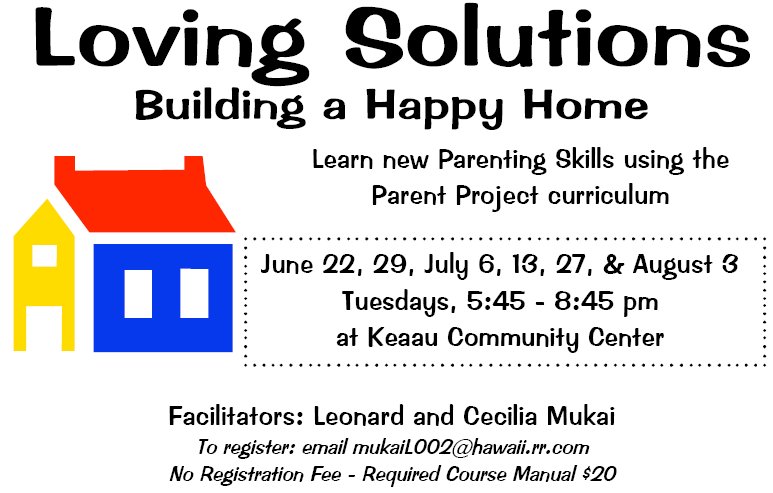
Keaau, Hawaii – Our good friends Leonard Mukai, Ph.D. and Cecilia Mukai, Ph.D. are hosting a new series of six (6) Loving Solutions – Building a Happy Home classes. They are waiving the $79 registration fee to the first 10 person to sign up, a $20 course manual is required. According to Leonard the program has an “extremely effective curriculum” and uses the Parent Project curriculum.
This a wonderful opportunity to take advantage of, for yourself or someone you know.
We would like to thank the Mukai’s for inviting “Starts at Home” to their new class to encourage parents and love children.
We are hoping and praying for more organizations to create new classes, seminars, training sessions, and counseling services, helping to spread a parenting revival.
Leonard Mukai
See you at class in beautiful Hawaii.
Aloha Ke Akua
Two different schools of thought exist on the subject of spanking vs. time-out as a discipline measure. My wife and I decided to stop spanking our children when we observed them beginning to hit each other. It dawned on us that they were mimicking our actions and that we needed to change our method of discipline. Thereafter, when our children misbehaved, we practiced “time-out” by having the children sit or standing in the corner for a period of time, and not enabling them to continue their action(s).
Sometimes spanking is used to discipline without parent’s exhibiting anger and used in private.
Should spanking be used it should be limited and done without anger as a last resort to break a non-tolerant behavior. The timeout method proved effective, as facing the wall not only stopped their negative actions but also enabled them to think about their behavior.
The practice of “time-out” may prevent the dangerous combination of hitting and anger, a combination that can escalate to child abuse. Spanking often escalates, becomes a continuous cycle, and only serves to show children that their parents have lost control. It’s very important for parents to be slow to anger and to retain their composure, the practice of “time-out” enables this.
The other important component of “time-out” is consistency, do the “time out” as soon as the child misbehaves and as often as is necessary. As an example, in sports, players are benched for violating the rules. The National Hockey League’s Rule 17.1 Bench Minor Penalty, involves the removal from the ice of one player for two (2) minutes. Your home’s time-out could range between 2-15 minutes depending on the severity of the rule not followed. Remember to keep your “cool” and not get angry, if you need to bring in your spouse or friend to give you a break, that’s wise as the child having a tantrum can be exhausting on the parent.
Your goal is to stop the use of tantrums by the child and not enable the child to continue this detrimental behavior that could continue through life.
Your rules and the importance of these rules can determine your home time-out durations, it’s up to parents to determine which rules are important, and very important.
The below is sorted from important to very important and how many minutes time-out could be.
Eating when its time to eat. 2 2 minutes and no meal till next meal time.
Putting away the toys 4 2 minutes
Taking away another persons toy or object 8 10 minutes
Hitting another person 8 10 minutes
Not obeying the parent 10 12 minutes
“Time-out” and being alone in the corner of a room is a form of punishment and is the opposite of being hugged or hearing the words “I love you”. Children inherently want to please their parents. As a method of enforcing desirable behavior in children, “time-out” is an immediate, more loving, and effective means of parental discipline.
In all matters, our love is the greatest gift we give our children.
**************
For related information in this website – search for tantrum
On June 27, 2002 The Associated Press released Columbia University’s analysis of six decades of research on corporal punishment linking spanking to ten negative behaviors including aggression, anti-social behavior and mental health problems. Continual spanking can have long-term negative effects.
Grandpa Carl and John enjoying our “Second Changes” that Welty is referring to; it is such a joy to be with the new and growing family.
It’s not very often that we get a second chance in life. When we have raised our children and we have aged, we tend to look back and more often than not wish we had spent a little more time listening and playing with our children. As we all know they just grew too fast and many of us feel that there were many missed opportunities.
The older we get, the more we realize what is truly important….it certainly isn’t a big career, fancy cars or a big house. It is the joy and love that comes with family and to those of us that God blesses with grandchildren, we truly do get a second chance. We now can take all day to listen and play with our children’s children.
The short temper that some of us had as parents seems to completely disappear and spending time with our grandchildren becomes a joy with true unconditional love. Our grandchildren believe grandma and grandpa know everything and can do anything. We all know this will soon pass too quickly, however we are embracing our second chances while they last.




 Starts at Home